Bigfoot: Fact or Folklore?
Bigfoot Traits
Bigfoot has intrigued people for generations and caused an uproar of questions concerning the authenticity of folkstory. A BBC Science Focus Magazine describes Bigfoot as “a large, hairy, human-like creature that roams the forests of North America – or so the myths and legends tell us” (Saunders). There have been many Bigfoot sightings throughout the years, the most well known sighting being the Patterson-Gimlin film from 1967 (1). With many reported sightings, the saying “seeing is believing” suggests that people only trust what they witness firsthand. However, today's modern knowledge perceives that “appearances can be deceiving”. By examining historical and science focused research, one can assess whether the Bigfoot phenomenon can be substantiated through the possible sightings or the local myths and folklore.
The legend of Bigfoot has long fascinated and divided audiences, raising the question of whether this mysterious figure can be substantiated as reality. Folklorist Linda Milligan observes, “Truth in most instances becomes a matter of faith not fact” (Milligan 84). Her statement highlights how Bigfoot’s existence is sustained less by empirical evidence than by cultural narratives and personal belief. Bigfoot endures as a cultural figure because of three defining traits: his elusiveness, his emotional resonance, and his symbolic power. These traits make him a lasting presence in folklore and popular imagination, regardless of scientific proof.
Bigfoot’s elusiveness is his most defining trait. He is rarely seen, never captured, and always just out of reach. This mystery fuels both skepticism and fascination. Scholars Jamie Lewis and Andrew Bartlett argue, “Bigfoot exists. If not as a biological creature, then as a cultural object about which people know with a high degree of stability” (Lewis and Bartlett). Their statement underscores that Bigfoot’s identity is not dependent on physical proof but on his stable presence in cultural memory. His elusiveness becomes part of his character, reinforcing his role as a figure who exists more in belief than in fact.
Beyond mystery, Bigfoot’s emotional resonance deepens his cultural significance. He evokes curiosity, fear, wonder, and even comfort. As Wildfoot Explores notes, “Despite modern science, this elusive being continues to spark debate, fear, and fascination… this creature is more than just a legend—it’s a phenomenon that has etched itself deeply into popular culture” (Wildfoot Explores). This emotional appeal explains why Bigfoot thrives across cultures and media platforms. Whether portrayed as a gentle giant or a terrifying beast, Bigfoot’s emotional presence ensures his relevance in public imagination.
Bigfoot’s symbolic power further reinforces his role as a lasting cultural figure. He represents the unknown, the wild, and the limits of human understanding. His symbolism is flexible—he can be a warning, a protector, or a mirror of human uncertainty. Toby Saunders explains that belief in Bigfoot persists because “people want to believe in something mysterious and unexplained” (Saunders). This desire reflects a human need for stories that challenge certainty and invite wonder. Bigfoot’s symbolic power transcends evidence, reminding us of what lies beyond civilization and comprehension.
Bigfoot’s character is built on traits that endure regardless of physical evidence. His elusiveness keeps him hidden, his emotional resonance keeps him relevant, and his symbolic power keeps him meaningful. These traits make him a lasting cultural figure—one who reflects our deepest questions about truth, mystery, and belief. Whether real or imagined, Bigfoot stands as a powerful symbol of the blurred lines between fact and folklore, showing that some stories persist not because they are proven, but because they are believed.
Bigfoot Conspiracy Theories
The first conspiracy theory argues that Bigfoot is a biological remnant of the Nephilim—giant offspring of fallen angels and human women described in biblical texts. In Genesis 6:4, the Nephilim are described as “mighty men of old, men of renown” (Genesis 6:4). This passage has long been interpreted as evidence of hybrid beings who lived before the flood. Researcher Ron Morehead, who has studied Bigfoot for decades, explains, “This Nephilim theory has its base on a compilation of, but not limited to, the Bible… The Book of Enoch, The Book of Giants… and my first book into quantum physics” (Morehead). By situating Bigfoot within this biblical tradition, Morehead reframes cryptozoology as a theological issue rather than a purely scientific one. The Bible itself provides compelling support for this theory. In Numbers 13:33, the Israelite spies report seeing giants in Canaan, saying, “We saw the Nephilim there… and we seemed to ourselves like grasshoppers” (Numbers 13:33). This description of towering, human‑like beings parallels eyewitness accounts of Bigfoot as a massive, intimidating figure. Similarly, Deuteronomy 2:10–11 refers to the “Emim” and “Anakim,” other giant peoples believed to descend from the Nephilim (Deuteronomy 2:10–11). These repeated references across scripture suggest that the existence of giant beings was not a one‑time occurrence but a recurring reality in biblical history. Morehead builds on these passages by arguing that Bigfoot
may represent a surviving branch of this lineage. He notes that consistent reports of large, human‑like creatures across cultures align with biblical descriptions of the Nephilim (1).
Supporters of the Nephilim theory often point to archeological anomalies. Morehead references enigmatic structures in Peru and Bolivia, as well as skeletal remains that appear non‑human, suggesting these findings support the possibility of hybrid beings outside mainstream historical narratives (Morehead). He also cites alleged DNA studies indicating Bigfoot’s maternal lineage is human, while its paternal side remains unidentified (1). These claims, though controversial, reinforce the idea that Bigfoot may represent a hidden lineage with biblical origins.
The second conspiracy theory argues that Bigfoot sightings are nothing more than mistaken identity. As Jan Otte notes in Are Bigfoot Sightings Actually Linked to Misidentified Wildlife, “The American Black Bear has a surprising ability to stand and walk short distances on its hind legs, mimicking an upright creature” (Otte). Bears, moose, and other large animals can resemble Bigfoot under certain conditions, especially in poor lighting or from a distance (1). This explanation is rational and grounded in nature, and it has been used to dismiss countless eyewitness reports (1).


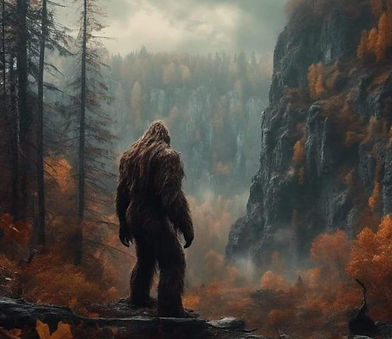


Unveiling Mystery
However, the conspiracy theory that Bigfoot sightings are nothing more than mistaken identity is not fully convincing. While bears can walk upright, many eyewitnesses describe creatures with distinctly human-like features, intelligent behavior, and vocalizations that do not match known wildlife (Otte). Furthermore, the persistence of Bigfoot legends across cultures and centuries suggests something deeper than simple misidentification. If Bigfoot were only a bear, the phenomenon would not have inspired such consistent folklore worldwide. Thus, the wildlife theory oversimplifies the mystery.
Works Cited
Lewis, Jamie, and Andrew Bartlett. “The Shape of Bigfoot: Transmuting Absences Into Credible Knowledge Claims.” Cultural Sociology, Aug. 2024, https://doi.org/10.1177/17499755241264879..
Milligan, Linda. “The ‘Truth’ about the Bigfoot Legend.” Western Folklore, vol. 49, no. 1, 1990, pp. 83–98. JSTOR, https://doi.org/10.2307/1499483. . Accessed 9 Oct. 2025.
Morehead, Ron. “The Nephilim Theory.” Ron Morehead | The Nephilim Theory, ronmorehead.com/the-nephilim-theory/. Accessed 12 Nov. 2025.
Otte, Jan. “Are Bigfoot Sightings Actually Linked to Misidentified Wildlife.” NewsBreak, www.newsbreak.com/animals-around-the-globe-312249899/4150752421039-are-bigfoot-sightings-actually-linked-to-misidentified-wildlife. Accessed 12 Nov. 2025.
Saunders, Toby. “Is Bigfoot Real? Why People Believe in the Sasquatch.” BBC Science Focus Magazine, 20 June 2023, www.sciencefocus.com/nature/is-bigfoot-real. Accessed 7 Sept. 2025.
The Holy Bible: King James Version. Genesis 6:4; Numbers 13:33; Deuteronomy 2:10–11
Wildfoot Explores. “Bigfoot Mystery: What Science Still Can’t Explain | Wildfoot Explores.” Embarking on a Journey into the World of Bigfoot and the Paranormal Realms, 7 Oct. 2025, wildfootexplores.com/bigfoot-legend-mystery-and-science-unveiled..
Exploring Bigfoot
%20(2).jpg)

Unveiling Mystery
Delve into the intriguing world of Bigfoot as we uncover the truth behind this elusive creature. From sightings to footprints, join us on a journey through folklore and facts. Our blog is dedicated to exploring the mysteries surrounding Bigfoot, providing you with the latest research, theories, and encounters. Stay tuned for captivating stories, expert interviews, and analysis that will keep you on the edge of your seat. Let's separate myth from reality and embark on an adventure to unravel the enigma of Bigfoot.